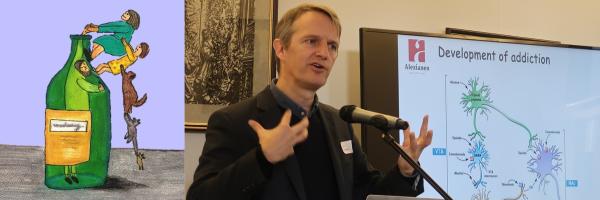
Hendrik PEUSKENS (EN)- About serenity to accept what cannot change, courage to change what can,& wisdom to know the difference
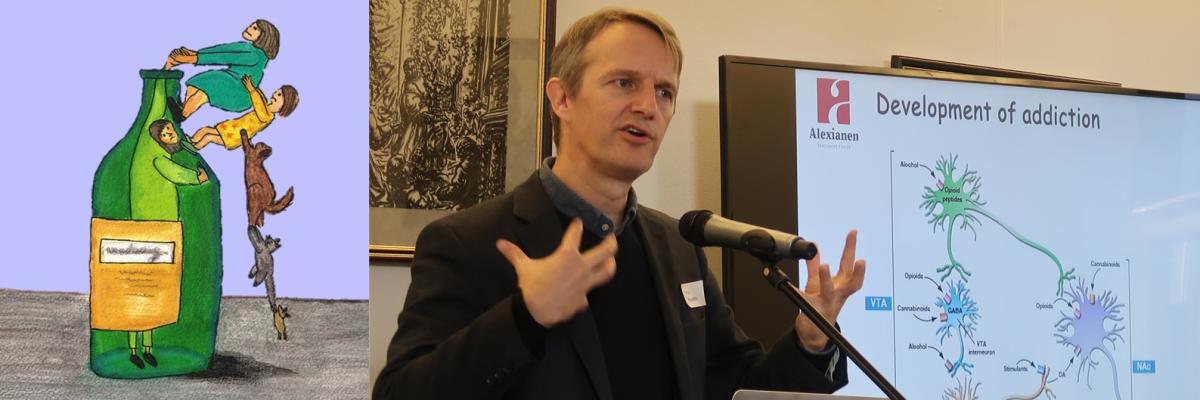
Brain mechanisms and (new) therapeutic opportunities in addiction
Dr. Hendrik Peuskens
Psychiatrist at the mental health centre for people with addictions of the Alexians, Tienen
Chairman of the Flemish Expertise Centre for Alcohol and Other Drugs (VAD)
Lecture given by Prof. dr.Hendrik Peuskens during the symposium on addiction on 21 October 2023 in Abbey of Grimbergen.
Reporter: Dr Stefan De Smedt
Development of addiction
According to the definition of National Institute on Drug Abuse, addiction is a chronic relapsing disorder characterized by compulsive drug seeking and use despite its adverse consequences. Addiction is a brain disorder where functional changes are implicated in brain circuits, that are involved during the reward, stress and self-control processes. These functional changes may last a long time even after the person has stopped taking drugs.
Dopamine neuron stimulation in the midbrain plays an important role in our learning process to get rewards and make us strive for more rewards, which is an evolutionary beneficial trait. For example, if we eat unexpectedly an juicy apple, there is a positive reward prediction error. Reward prediction errors consist of the differences between received and predicted rewards. Dopamine neurons are activated by more reward than predicted (positive prediction error in case of lots of juicy apples), remain at baseline activity for fully predicted rewards, and show depressed activity with less reward than predicted (negative prediction error in case of a sour apple ). Thus, the dopamine stimulation arising from a natural reward may directly induce behavioral learning and actions. Every time we see a reward, the responses of our dopamine neurons affect our behavior. They are like “little devils” in our brain that drive us to rewards!
The basal ganglia (nucleus accumbens NAc and dorsal striatum), the extended amygdala, and the prefrontal cortex are areas of the human brain that are especially important in addiction and interconnected to each other. Addictive substances have converging acute rewarding actions on the NAc. Dopamine neurons that originate in the ventral tegmental area (VTA) project to the NAc. Opioid peptides act both in the VTA and NAc. These stimulants directly increase dopamine (DA) transmission in the NAc. Opioids, alcohol, and inhalants (e.g., the solvent toluene) do the same indirectly.
Alcohol also activates the release of opioid peptides. Heroin and prescribed opioid pain relievers directly activate opioid peptide receptors. Nicotine activates dopamine neurons in the VTA. Cannabinoids act in the VTA to activate dopamine neurons but also act on NAc neurons themselves.
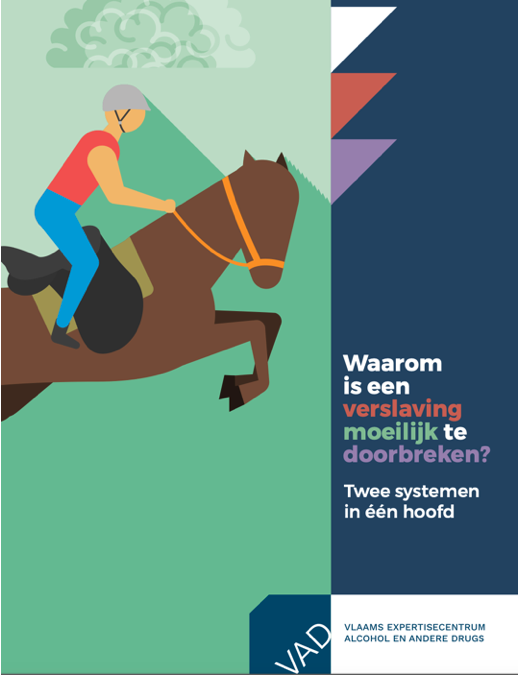
Drugs of addiction generate, hijack, and amplify the dopamine reward signal and induce exaggerated, uncontrolled dopamine effects on neuronal plasticity. Thus, the important concept of reward prediction errors is implemented in neuronal hardware. Dopamine stimulation will direct automatism and will adjust a person’s behaviour to seek more reward. Desensitivation of the dopamine circuits will make a person long more and more to the rewarding substance even in higher dosis, and this desensitisation is visible on non-invasive neuro-imaging. This can lead to diminished response inhibition by the (prefrontal) cortex. The reflective (cortical) system (the “horseman”) risks to loose control over the impulsive (midbrain) system (the “horse”). External stimuli, emotional feelings and memories can arouse automatic, thinking, attention and behaviour.
Influence of an addiction prone environment
In the development of addiction many triggers play a role, not only biological ones (genetic predisposition, early age at onset), but also psychological (trauma, life events) and environmental factors (availability, publicity). This environmental trigger has not to be underestimated. Addiction is socially engineered exploitation of natural biological vulnerability. Almost all human addiction is “socially engineered”. It results from humans’ social capacity to manufacture and efficiently distribute flows of addictive products, a capacity that could not be selected against in the evolution of the brain. People are confrontated with publicity for cigatettes, alcohol, food, gambling, internet, games, pornography…Empathy with addicts can be based partly on viewing them as victims – not of their brains, but victimised by other predator humans.
Treatment of addiction
Although not always (immediately) possible, enhancement of motivation of the patient to change behaviour is important in the treatment of addiction. Secondly, it is of paramount importance to tackle addiction in its early stages by brief interventions at any opportunity. Another key principle is to realise that addiction treatment will take a long time and therefore needs to be sustained. It is not only based on detoxing the addicted person, but also involves taking care of all the patient’s needs (medical /psychiatric comorbidity, social/ familial situation, economical/vocational issues…).
It is important to tackle addiction in its early stages by brief interventions at any opportunity and to continue its treatment for a long time.
If the patient is motivated for quitting, the steps to follow are detoxification, abstinence, relapse prevention and sobriety. Psychotherapy during cognitive behaviour therapy sessions can help the patient to identify triggers, prevent automatic behaviour, tackle craving, install new rewards and pick up in case of relapse. Medical therapy also has a role to play by tapering the addicting agonists or by offering a symptomatic treatment. In the relapse prevention some medication can be useful (disulfiram, naltrexone, acomproate). Acceptance and commitment therapy helps people live a conscious and valuable life, by teaching them how to deal with unpleasant feelings, take a healthy distance from negative thoughts and addiction (acceptance), and focus on new perspectives and activities that are really important in their life (commitment).
Sometimes only motivation for moderation is faisable as a first step by taking measures to moderate its use (via nalmefene, naltrexone). Occasionally motivation for change is lacking, in which case harm reduction is key. Intravenous opioids are substituted by oral methadone or buprenorphin. Used syringes are exchanged for sterile ones to reduce chances of intravenous infections or hazardous environment of abandoned syringes. Other initiatives in line with this approach are Pondo/ Mapa and Housing First. Pondo is a supportive preventive network that works with drug-using parents to find a way to responsible parenting. The safety of the (un)born child is central. Housing First aims to socially integrate the most vulnerable homeless people, often with physical/mental health and/or addiction problems, by offering them a roof over their heads and appropriate counselling.
«God, grant me the serenity to accept the things I cannot change,
The courage to change the things I can,
And the wisdom to know the difference.”
Serenity prayer: Reinhold Niebuhr
Conclusion
To conclude, addiction involves functional brain changes that make the addict less adapted to resist against an addiction prone environment. Its management is not limited to medically stopping addictive behaviour, but addresses different life domains. Understanding addiction implies a biopsychosocial model.
References
- Schultz W. Dopamine reward prediction error coding. Dialogues Clin Neurosci. 2016
- https://www.ncbi.nlm.nih.gov/books/NBK424849/
- Ros D. Behavioural Brain Research, 2020
15/12/2023
This article was previously published in Acta Medica Catholica 2023-2
(paper edition)
Dit artikel uit ons tijdschrift wordt gratis ter beschikking gesteld. Om verder te lezen, moet u geabonneerd zijn en ingelogd. U bezoekt deze pagina als gast en bent nog niet ingelogd. De financiële steun van onze abonnees is een waardevolle hulp voor onze werking! Hartelijk dank!
Verder lezen als abonnee
Verder lezen als gast
Terug naar STARTPAGINA
Acta Medica Catholica ARCHIVES
Read a selection of previously published articles taken from our journal "Acta Medica Catholica-paper edition” below.

Harko IJKEMA (NL) - If sex has become addictive: insights from an addiction therapist

Pascal IDE (FR) - Addiction: dissociation between object and pleasure; artificial paradises and drugs as a substitute for Eternal Life

Benoit BEUSELINCK (EN- One may not add days to life, but one may add life to days

François TRUFIN (FR) - Old age keeps watch at eternity’s door, calling us back to what truly matters

Lotte VOETS (ENG) - Compassionate Dutch palliative care honors dignity and unique needs of people with intellectual disabilities